REVIEW · ISTANBUL
Istanbul to Seven Churches of Asia Minor 4 Nights in 4 Star Hotels
Book on Viator →Operated by Private & Small Group Ephesus & Istanbul & Turkey Tours · Bookable on Viator
Seven churches in western Turkey feel like a road trip with purpose. This short, organized route follows the Bible’s trail of the Seven Churches of Asia, tying specific verses to major ruins and holy sites. You also get real comfort—4- and 5-star hotels in the key bases—without turning every day into a logistics puzzle.
I love how much is bundled into your day: entrance fees are included, the guide has pre-paid tickets to help you skip lines, and you get breakfast plus two dinners. I also like that the trip is built for Christians who want meaning, not just photo stops—your guide uses the Bible verses tied to each church as you move from Pergamon to Ephesus.
One possible drawback to plan for: it’s a packed route with a lot of driving across a few different ancient cities. If you prefer slow mornings and lots of free time, you might feel the schedule moving quickly.
In This Review
- Why This Seven Churches Route Works
- Istanbul-to-Western Turkey: A Smart Starting Plan
- Day One: Flight to Izmir and Settling In
- Pergamon and Thyatira: Two Churches, Two Different Kinds of Power
- Pergamon Ancient City
- Tepe Mezari and the Thyatira Connection
- Sardis, Philadelphia, and Laodicea: The Verses Get Specific
- Sardis (Sardes)
- Philadelphia (Alasehir) and the Only Uncensored Church
- Laodicea
- Hierapolis and Pamukkale: A Healing City With a Hard-Edged Story
- Ephesus and the Virgin Mary Sites: The Big Day
- Ancient City of Ephesus
- Meryemana: Virgin Mary’s House
- St. John’s Basilica
- Temple of Artemis and Kusadasi Night
- Day Five: Kusadasi Park, Then Flight Back to Istanbul
- Hotels, Meals, and What You Should Actually Watch For
- Value Check: What You’re Paying For Beyond “Sights”
- Who This Tour Suits Best
- Should You Book It
- FAQ
- FAQ
- How long is the tour?
- Where do I fly, and what’s included in the flights?
- What kind of hotels do you use?
- Are entrance fees to the sites included?
- What meals are included?
- Do I get private transfers?
- Is there a vegetarian meal option?
- Is cancellation flexible?
Why This Seven Churches Route Works
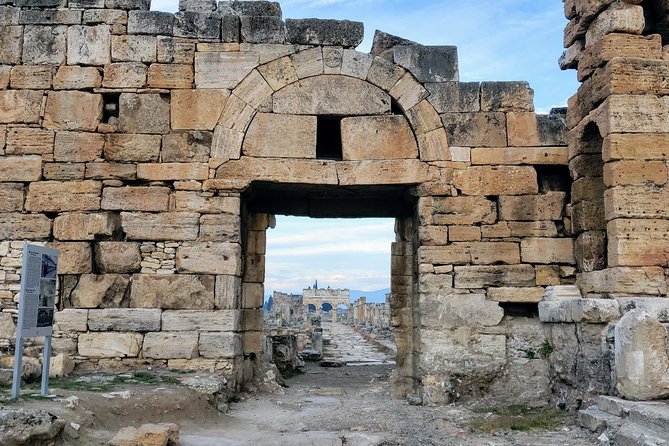
- Bible verses mapped to real ruins at Pergamon, Sardis, Philadelphia, Laodicea, and Ephesus
- Pre-paid entrance tickets help you spend less time in lines and more time looking closely
- Three hotel bases (Izmir, Pamukkale, Kusadasi) keep the travel days efficient
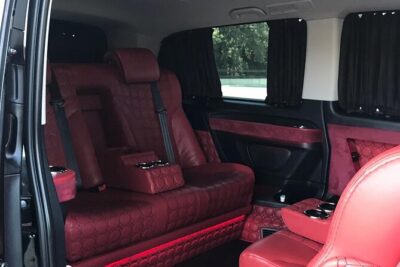
- Comfort included, with air-conditioned minivans and 4 nights in 4- and 5-star hotels
- Private transfers at the start and end in Istanbul reduce stress
- Small group size (max 15) helps you hear the guide and ask questions
Istanbul-to-Western Turkey: A Smart Starting Plan
This tour is designed around the geography of Turkey’s Aegean coast. Instead of trying to drive from Istanbul all the way to the Seven Churches region, you fly Istanbul to Izmir, then work your way through the ancient cities and religious sites that match the churches.
You’ll also get private transfer service in Istanbul, picking you up from either the European or Asian side (time details come after booking). For many people, that’s the biggest relief: getting out of Istanbul is hard even when you know what you’re doing. Here, you’re handled from door-to-door.
The included flights matter for value too. The price isn’t only paying for sights; it’s also paying for transportation that would be annoying to stitch together yourself—especially flights plus domestic baggage limits. The tour specifies 15 kg checked and 8 kg cabin, so you can pack with confidence rather than guessing.
You can also read our reviews of more tours and experiences in Istanbul.

Day One: Flight to Izmir and Settling In
Your day starts at Istanbul Airport with a flight to Izmir Adnan Menderes Airport. Once you land, a representative meets you and you go by private transfer straight to your Izmir hotel.
You’re not wasting Day 1 rummaging through transit options. That matters because the rest of the week becomes busy fast. Starting with a smooth transfer means you can focus on rest and then meet the day’s history with better energy.
Pergamon and Thyatira: Two Churches, Two Different Kinds of Power
Day two is where the trip becomes real. You visit Pergamon—one of the church sites mentioned in the Bible—and you get the full feeling of what made this place important: a dramatic acropolis setting, major monumental zones, and layers of religious meaning.
Pergamon Ancient City
Expect a guided walk through the impressive Acropolis, plus the Asklepieion (a major healing center in the ancient world). The guide also points out the Altar of Zeus, tied in the tour narrative to the Revelation reference about the Throne of Satan.
Pergamon tends to reward people who like details. You’ll be seeing how religion, politics, and public life all crowded into the same spaces—then your guide reconnects those physical impressions to the Bible verses for this church.
Tepe Mezari and the Thyatira Connection
After Pergamon, you head toward Thyatira (now associated with Akhisar). Here, the visit includes remains of a basilica and some Roman architectural fragments. Because the area also links to the Lydia background through the purple-dye trade, the guide can add texture to the biblical references beyond pure archaeology.
This day also includes a short panoramic ride connected to Smyrna. Even when time is limited, panoramas can be helpful on this kind of tour. You get the sense of geography—the way cities sit and how people would have moved between areas.
Then you finish with dinner and overnight, which is the right pacing after a full day of ruins.
Sardis, Philadelphia, and Laodicea: The Verses Get Specific
On day three, you’ll feel the tour tightening around the Bible text. The guide doesn’t treat these places as generic ancient cities; it’s more like a guided map where each church is a chapter.
Sardis (Sardes)
You depart early for Sardis, which the tour frames as a “dying church” reference. The site includes the Temple of Artemis, plus the Temple of Cybele, which the tour connects to a later Byzantine church use.
A big bonus here is variety. You’ll also see a restored gymnasium area and a reconstructed synagogue, which gives you more than temples and walls. Then there’s a smart historical stop along the royal Persian Road route from Susa, built under Cyrus the Great, plus the Pactolus river connection the tour links to the “golden” story.
If you like when history comes with specific names and routes, you’ll appreciate this stop.
Philadelphia (Alasehir) and the Only Uncensored Church
Next is Philadelphia, identified with Alasehir. In the Bible narrative used on this tour, this is the one church framed as not censured. At the site, you’ll see remains of a Byzantine basilica built with brick, with a high arch and visible frescoes dated to the 11th century.
This is the kind of place that feels smaller than Ephesus, which can be a good thing. Instead of fighting crowds, you focus on the building details and the quiet meaning of the site.
Laodicea
Then you head to Laodicea, described as the last of the seven churches on this route. The tour connects the city’s name to Laodicea and explains the setting along the Lycus Tributary of the Meander River—plus the “Laodicea on Lycus” nickname to separate it from other similarly named cities.
Why Laodicea matters here is its position as a crossroad for roads and commerce. Even if your interest is Bible-focused, that economic geography helps the verses make more sense. People lived in these places for a reason, and routes shape what kind of society forms.
Hierapolis and Pamukkale: A Healing City With a Hard-Edged Story
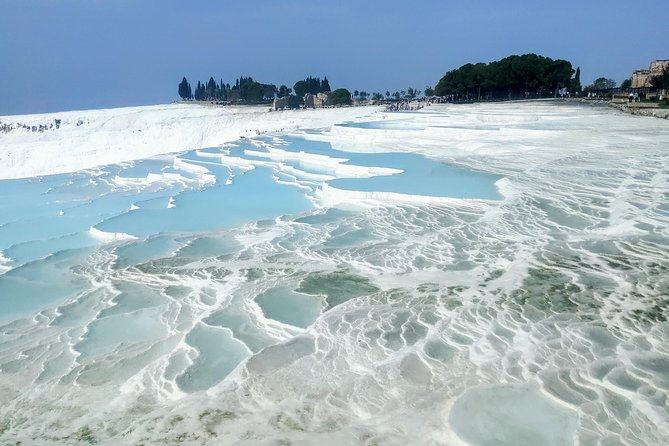
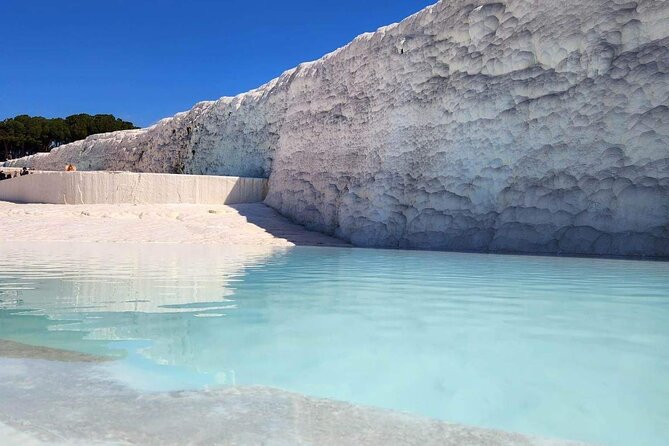
Finally, day three ends at Hierapolis—with the famous Pamukkale “white cotton fortress” mineral terraces. The tour frames this as a healing city and ties it to the mineral waters known to the founders of the region in 190 BC.
You’ll see the hot mineral water cascading over steep cliffs into pools and channels. This is one of those sights that feels almost unreal, which is exactly why it works as a contrast after the dry, stone-heavy ruins of the earlier stops.
The tour also includes the Martyrium of the Apostle Philip, connected to the Bible reference in Colossians 4:13 and to events tied to persecutions ordered by Domitian. It’s not just a pretty landscape here; it’s tied to a belief story.
Ephesus and the Virgin Mary Sites: The Big Day
Day four is the centerpiece day for many people. It includes the Ancient City of Ephesus, plus the Basilica of St. John, the Virgin Mary’s House (Meryemana), and more.
Ancient City of Ephesus
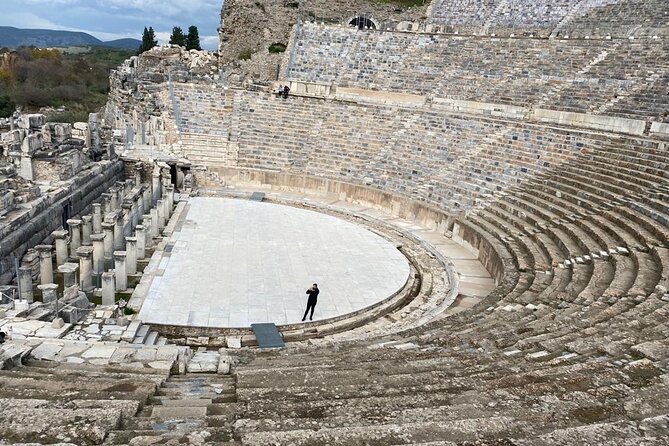
You’ll spend time in the ancient city, and the tour highlights several standout landmarks: the Basilica of St. John, the marble streets, the Baths of Scholastica, the Library of Celsus, the Temple of Hadrian, and the Theatre.
The guide also brings the Bible connection in plain terms—Paul preached here and lived in the region for years, and this church received a letter from him. That kind of link is what makes Ephesus feel less like a museum and more like a story with continuity.
One of the seven wonders references is also part of the mix through the Temple of Diana of the Ephesians. It’s a quick stop, but the guide’s framing helps you understand why this place was so famous in the ancient world.
Meryemana: Virgin Mary’s House
After Ephesus, you go to the House of Virgin Mary on the Aladag Mountains, about five miles away. The tour ties the site to the 5th-century tradition that Mary came to Ephesus with St. John and lived there until her death, plus the later pilgrimage recognition.
A detail I think you’ll like: the tour mentions Pope Paul VI visiting this place and praying there in 1967. That gives the site a modern religious footprint, not only an ancient legend.
St. John’s Basilica
Then you head to St. John’s Basilica, linked to the belief that the evangelist spent his last years in the region around Ephesus and was buried on Ayosolug Hill.
This is the kind of stop where even if you’re not deeply religious, the sense of place can feel powerful. A guided visit keeps it from becoming just “another church ruin.”
Temple of Artemis and Kusadasi Night
You also stop at the Temple of Artemis (a short visit) before driving back to Kusadasi. Then you check into your Kusadasi hotel, with dinner and overnight.
This is where the tour’s structure pays off. You finish your history-heavy day and still get real rest in a hotel base close to the next-day departure logistics.
Day Five: Kusadasi Park, Then Flight Back to Istanbul
On your last day, you’re not thrown straight into a frantic airport sprint. You get a pickup from your Kusadasi hotel for a transfer that includes time at Gazi Begendi Park.
After that, you go by private transfer to Izmir airport, fly back to Istanbul, and then end with another private transfer to your Istanbul hotel.
That pacing reduces the “last day scramble” stress that can happen on multi-city tours. It also gives you a final, easy break after days of driving and walking.
Hotels, Meals, and What You Should Actually Watch For
The tour includes 4 nights in 4- and 5-star hotels, with specific suggested properties by area: in Izmir, places like DoubleTree by Hilton Alsancak or Hilton Garden Inn Bayrakli (or similar). In Pamukkale, Colossae Thermal or Pam Thermal Hotel (or similar). In Kusadasi, Efe Boutique (or similar).
That “or similar” line is normal, but it means your exact hotel might change. Still, you can reasonably expect the same comfort level and hotel zone: this is about convenience while you see the Seven Churches region.
Meals are partly included. You get 4 breakfasts and 2 dinners, while lunch and drinks are not included. So if you care about lunch planning, you’ll want to budget time and money for it as you go. For many people, that’s fine because the tour’s included lunches aren’t listed as a feature; you’ll often have lunch en route.
Value Check: What You’re Paying For Beyond “Sights”
At $1,189 per person, this price is easiest to judge by what’s included.
You’re getting:
- Round-trip domestic flights (Istanbul ⇄ Izmir) plus baggage limits
- Private transfers in Istanbul at the start and end
- Transportation in an air-conditioned minivan/minibus
- 4 nights in mid-to-upscale hotels
- Entrance fees for the included sites, with pre-paid tickets via your guide
- A professional Bible-oriented guide
- 4 breakfasts and 2 dinners
In practice, that means you’re paying for less decision-making. You don’t have to compare tickets, plan driving between far-apart sites, or figure out where the best entrances are. You also avoid wasting time with “ticket line roulette,” since the guide is set up to help you skip lines.
The main “pay attention” item is meals outside breakfast/dinner and drinks. Also, remember it’s a short trip built around multiple cities, so the daily schedule can feel full.
Who This Tour Suits Best
This is a strong fit if:
- You want the Seven Churches of Asia experience with Bible-focused interpretation
- You like organized pacing and don’t want to plan routes between archaeological sites
- You value comfort—good hotels, air-conditioned transport, and included entrance fees
- You prefer a small group (max 15) and a guide you can actually hear
It may be less ideal if:
- You want lots of free time for wandering or slow café hours
- You’re sensitive to long driving days (the itinerary hits multiple cities in a tight window)
- You’re mainly after beach time, since the structure is almost entirely history-and-faith centered
Should You Book It
If you’re going to the Seven Churches region and you want it done the easiest way—flights, hotels, entrance fees, and a Bible-oriented guide included—this is the kind of plan that saves both time and mental energy. The route also hits big emotional and visual contrasts: Pergamon and Ephesus for scale, and Pamukkale for that unforgettable “white terraces” moment.
I’d book it if Bible verses and guided meaning matter to you as much as the ruins. I’d think twice if you want a low-intensity trip with lots of independent downtime.
FAQ
FAQ
How long is the tour?
The tour runs for about 5 days, including travel days, based on the day-by-day schedule.
Where do I fly, and what’s included in the flights?
You fly from Istanbul to Izmir and then back from Izmir to Istanbul. Domestic flights are included, with a stated luggage limit of 15 kg checked and 8 kg cabin.
What kind of hotels do you use?
You get 4 nights in 4- and 5-star hotels. In Izmir, suggested options include DoubleTree by Hilton Alsancak or Hilton Garden Inn Bayrakli (or similar). In Pamukkale, options include Colossae Thermal or Pam Thermal Hotel (or similar). In Kusadasi, an option includes Efe Boutique (or similar).
Are entrance fees to the sites included?
Yes. Entrance fees are included, and the guide has pre-paid tickets to help skip the lines.
What meals are included?
The tour includes 4 breakfasts and 2 dinners. Lunch and drinks are not included.
Do I get private transfers?
Yes. Private transfers are included in Istanbul at the start and end of the tour (hotel to airport and airport to hotel). Private transfers are also used for the Istanbul end-to-end flow and the Izmir airport transfer on the final day.
Is there a vegetarian meal option?
A vegetarian option is available. You need to advise at booking.
Is cancellation flexible?
You can cancel up to 6 days in advance of the experience for a full refund, with partial refunds available if you cancel 2–6 days before the start time.
![Troy Tour from/to Istanbul [incl. lunch] - Sacrificial Altars: religion you can almost feel in the layout](https://cd.theistanbultraveller.com/wp-content/uploads/troy-tour-from-to-istanbul-incl-lunch-400x266.jpg)