REVIEW · BASILICA CISTERN TICKETS
Istanbul: Basilica Cistern Skip-the-Line Entry & Audio Guide
Book on GetYourGuide →Operated by Istanbul Tourist Pass® · Bookable on GetYourGuide
A cool underground world awaits in Istanbul. The Basilica Cistern is a literal 4th-century water machine, and the guided format makes the myths, the architecture, and the famous Medusa heads feel way easier to follow. I especially like how the guide stories bring in details like the Medusa heads and the Justinian-era plumbing, and I also like having optional support from the audio guide while you explore on your own. One thing to keep in mind: even with skip-the-line entry, you still can’t skip the mandatory security checks at the entrance.
Timing matters here. The experience usually runs around 1 hour to 75 minutes, and the cistern can get noisy if groups arrive close together, like school trips. If you go at peak hours, you might also notice construction or special installations during your visit, which can slightly change the vibe of a sight that’s already a little strange in the best way.
In This Review
- Key Highlights You’ll Feel Right Away
- Basilica Cistern Skip-the-Line: What It Really Saves You
- Meeting Up and Getting Oriented Before You Go Underground
- Descending 52 Stone Steps Into a Justinian-Era Water System
- The “Medusa Heads” Story: Myth Meets Muddy Water
- Architecture and Lighting: Why It Feels Like a Scene From Another Century
- Hagia Irene and Bosphorus Views: How the Tour Connects You to the Surroundings
- Audio Guide Support: When It’s Better to Listen on Your Own
- eSIM: A Small Add-On That Helps Big-Time
- Pricing ($54): Is It Good Value for Your Time?
- Guides That Make the Difference (Names to Look For)
- Practical Tips So You Get the Best Visit
- Should You Book This Basilica Cistern Skip-the-Line Ticket?
- FAQ
- How long does the Basilica Cistern skip-the-line experience take?
- What’s included with the ticket?
- Is the audio guide included automatically?
- Does this skip the security line?
- What do I need to bring to enter?
- Is hotel pickup included?
- Where do we meet and where does it end?
- Do I get a QR code for entry?
- What’s the cancellation policy?
- Can I reserve and pay later?
Key Highlights You’ll Feel Right Away
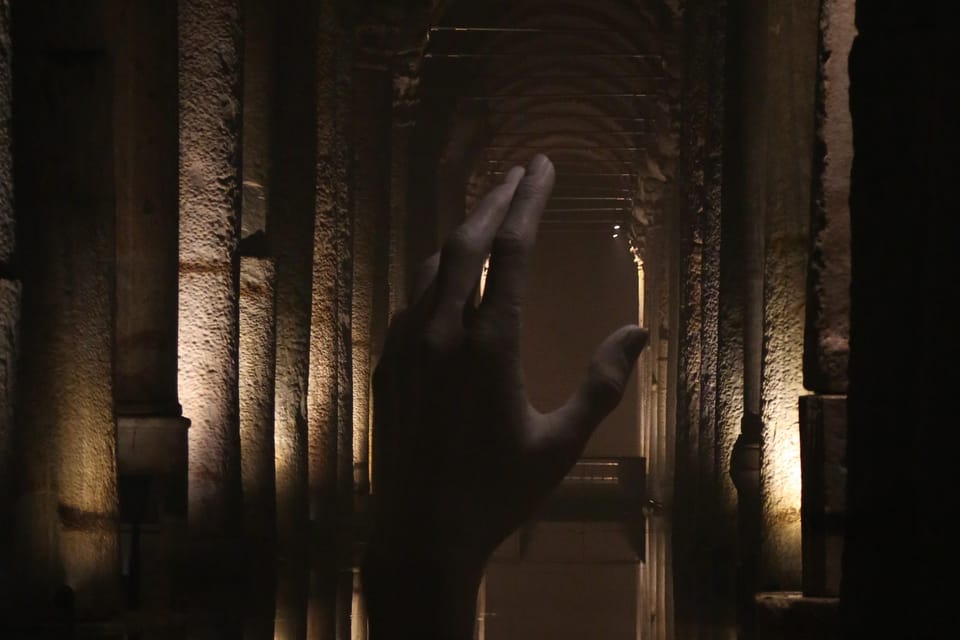
- Skip-the-line entry helps you get inside faster, even though security lines are still required.
- Medusa heads explained with Greek-myth context that makes the sculptures less random.
- James Bond detail: you can connect what you see to a scene from From Russia with Love.
- Justinian’s water engineering: 80,000 cubic meters stored and long aqueduct runs.
- A guided-and-then-freestyle visit: you get the story first, then time to look, photograph, and linger.
Basilica Cistern Skip-the-Line: What It Really Saves You
The main reason to book this style of ticket is simple: Istanbul’s Basilica Cistern is popular, and waiting around in lines is the opposite of fun. With skip-the-line entry (when that option is selected), you’re set up to enter ahead of the big bottlenecks.
That said, don’t expect a magic wand. You still have to go through mandatory security lines. Also note that you’ll get your Entry Ticket QR Codes link by email from the Istanbul Tourist Pass, and you’ll need to show your passport or ID card at the venue.
So the smart takeaway is this: your time savings come from avoiding the main ticket queue, not from skipping security entirely. If you want the smoothest entry, choose an earlier start time when available.
You can also read our reviews of more guided tours in Istanbul



Meeting Up and Getting Oriented Before You Go Underground
The meeting point can vary based on the option you select, but the good news is the activity ends back at the meeting point. That loop matters if you’re squeezing this into a day packed with Sultanahmet sights.
When you arrive, plan to look for your guide and group before you even think about photos. Several experiences are tight on timing, so it helps to get your bearings early—especially because once you start down into the cistern, you’re moving into a colder, dimmer world where it’s easy to lose track of time.
If you like being organized, bring your passport/ID ready. It’s one less moment of fumbling when staff ask for it.
Descending 52 Stone Steps Into a Justinian-Era Water System
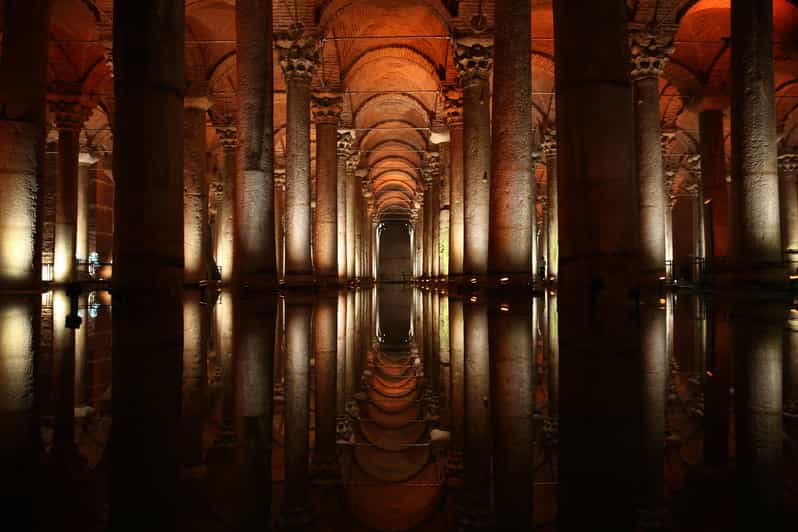
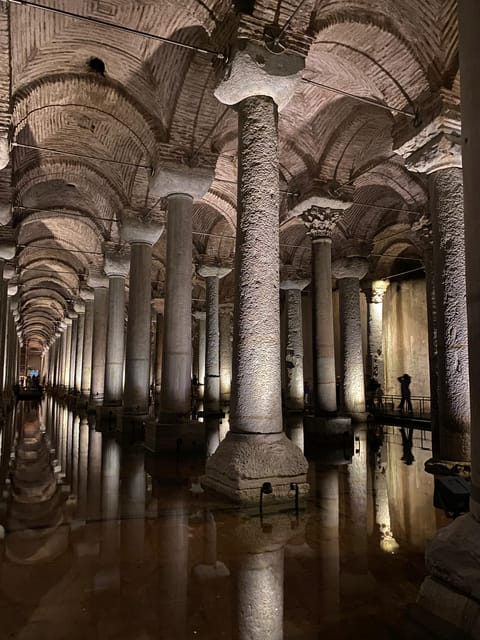
The Basilica Cistern effect hits before you even reach the water room. You descend 52 stone steps, and the shift is immediate: cooler air, quieter acoustics, and that surreal “how is this still standing?” feeling.
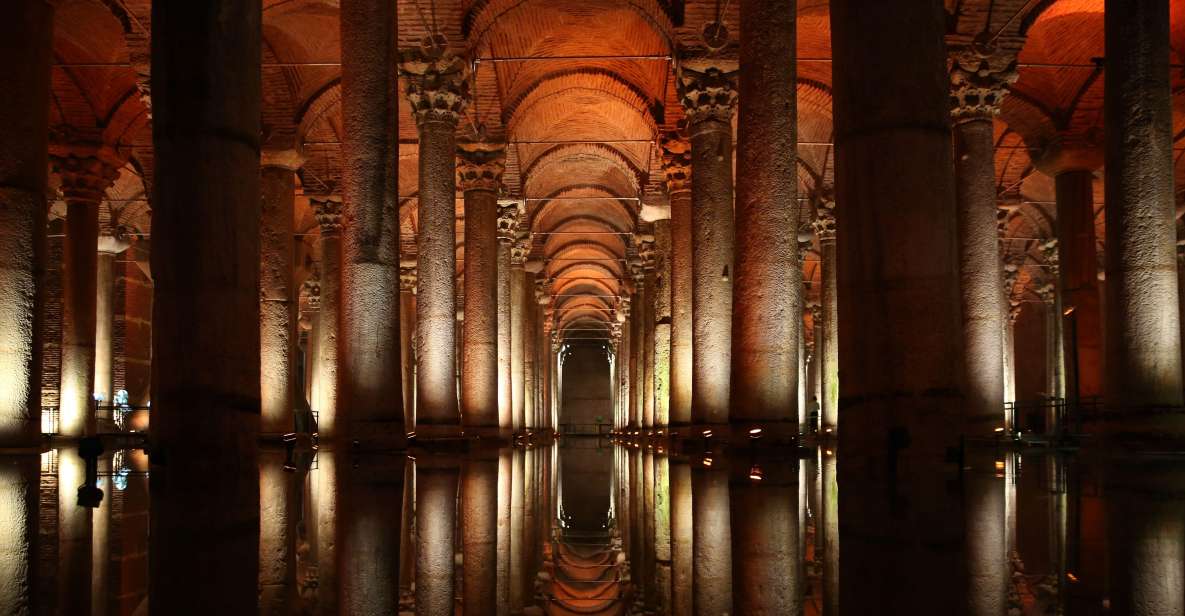
The cistern is often described as cathedral-like, and that comparison is fair. It was built in the 4th century, then enlarged in 532 AD during the reign of Emperor Justinian I. In practical terms for your visit, this means you’re not just seeing a tourist attraction—you’re walking inside a massive piece of infrastructure that once fed the Great Palace with stored water.
Then comes the engineering talk, and it’s exactly where a good guide earns their fee. You’ll hear that the cistern stores up to 80,000 cubic meters of water, delivered via 20 kilometers of aqueducts. It also helps you picture the cistern as part of a whole network, not a standalone pool.
If you’re into details, the information is specific: water traveled from the Eğrikapı Water Distribution Center in the Belgrade Forest through the Valens Aqueduct (971 meters) and the Mağlova Aqueduct (115 meters). That makes the visit feel grounded—even when the myths and pop-culture references start flying.
The “Medusa Heads” Story: Myth Meets Muddy Water
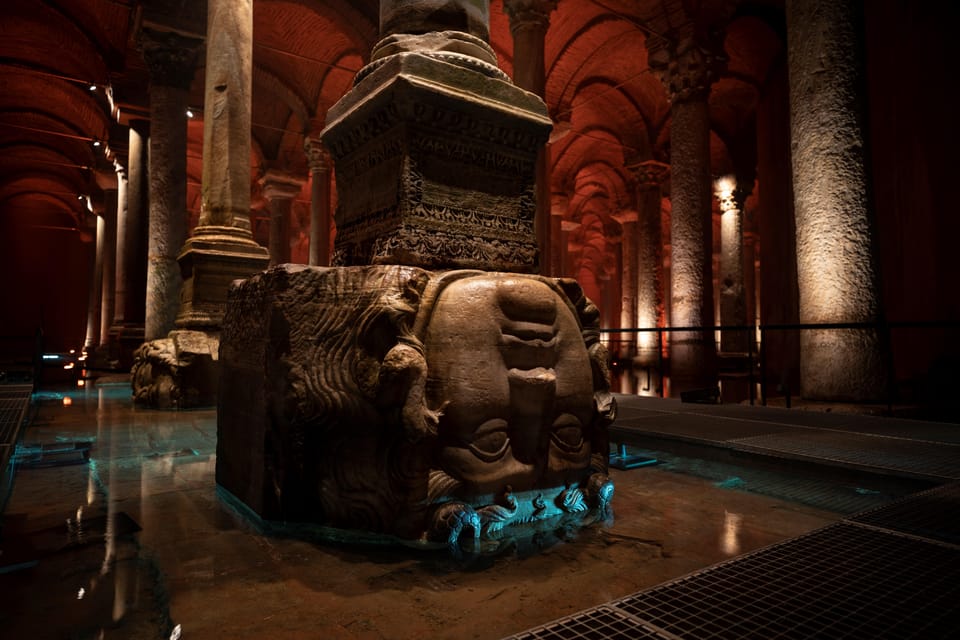
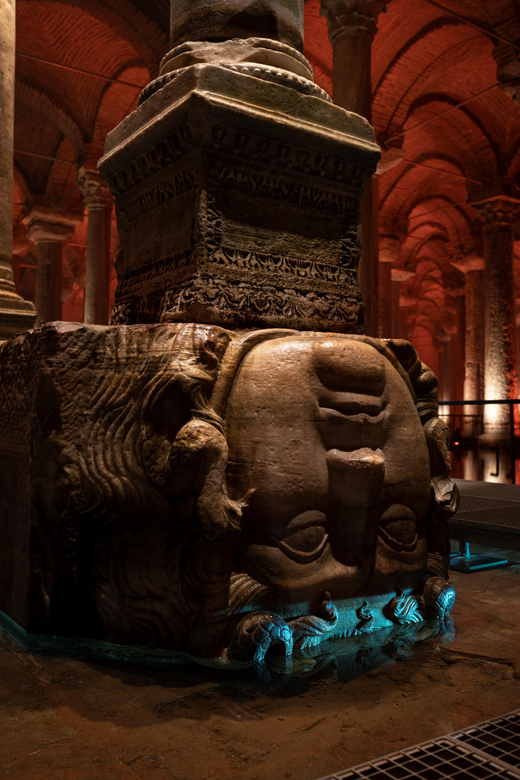
One of the most praised parts of this experience is the way the guide tells the story behind the Medusa heads. Instead of treating them like spooky decoration, your guide connects them to Greek mythology and explains why these sculptures have become a puzzle people love to talk about.
This is where I’d recommend you lean in. The cistern is visually striking, but the myths are what keep it interesting after the first wide-eyed moment. With the right storytelling, you start noticing details you’d otherwise overlook—like how the sculptures are positioned and how they fit into the cistern’s weird, dreamlike mood.
Also, your guide may point out the famous visual connection to cinema: a scene from the James Bond film From Russia with Love. That reference is useful because it gives your brain a handle. You stop thinking only about myth, and start noticing how the same visuals became part of modern storytelling.
Architecture and Lighting: Why It Feels Like a Scene From Another Century
The cistern’s design does a lot of the work for you. It has thick defensive-style walls—described as a firebrick wall with 4 meters thickness—and it used waterproofing mortar. Even if you don’t memorize those numbers, knowing they exist changes how you look at everything.
The visit can also feel a bit like walking through a set. Colored lighting can make the space feel cinematic, and many people love that look in photos. But keep your expectations flexible: some experiences note that there may be modern sculptures or installations present, which can feel slightly out of place if you’re expecting pure ancient atmosphere.
And yes, you might see signs of renovation or portions under repair. That doesn’t ruin the core experience, but it can change what you’re able to view in full. If you’re the kind of traveler who wants everything perfectly pristine, you’ll want to know this is a living, maintained site—not a frozen-in-time museum room.
You can also read our reviews of more tours and experiences in Istanbul




Hagia Irene and Bosphorus Views: How the Tour Connects You to the Surroundings
Even though the star is the Basilica Cistern, the highlights point to a broader orientation around Istanbul. You may get help recognizing nearby landmarks like Hagia Irene, described as the second biggest church of Istanbul, and you may also catch views over the Golden Horn and Bosphorus.
Because the details on timing and exact walking stops aren’t fully spelled out here, I’d treat this as “expect orientation and possible photo moments,” not a guaranteed long sightseeing detour. In a well-run tour, those side references matter—they turn your cistern visit from a one-off stop into part of understanding the neighborhood.
So if you’re pairing this with other Sultanahmet-area sights, think of it as a way to connect stories. You’ll go underground for water history, then your brain can pop back up and re-map the area above.
Audio Guide Support: When It’s Better to Listen on Your Own
This experience includes an audio guide option in English. That’s handy if you want to control your pacing during the part where you explore on your own.
In practice, audio guidance is most useful when you’re standing still enough to take in the details—like when you want context on the cistern’s design or want an extra pass at the Medusa story without needing to follow group pacing.
It’s also a nice backup if the group is noisy. Some people note noise from other groups, like a school trip behind them. A good guide can adjust the flow, but having the audio means you can still focus when sound carries.
eSIM: A Small Add-On That Helps Big-Time
The ticket package includes internet with an eSIM (limited time). This isn’t just a convenience perk. It’s useful when you’re juggling meeting points, figuring out what’s next after the cistern, or simply wanting to stay in touch while you explore.
If you don’t want to hunt for Wi-Fi every time you switch neighborhoods, this matters. Istanbul is easier when you can check maps, send a message, or look up a photo reference while you’re standing in front of something that famous.
Pricing ($54): Is It Good Value for Your Time?
At $54 per person, you’re paying for three core things: skip-the-line entry (when selected), guided storytelling, and extras like the audio guide plus the limited-time eSIM.
Is it worth it? If you’ve ever visited major attractions in peak season, you know how fast an hour can evaporate. If skip-the-line saves you from a long ticket queue, it’s already buying back time you can spend inside the cistern where it counts.
The guided component is the real value engine. The Basilica Cistern is pretty even without a guide, but the best part is how the guide explains the mystery of the Medusa heads and the cistern’s water engineering—plus the pop-culture and local landmark cues. That turns a 1-hour stop into a more memorable experience you can actually retell.
If your budget is tight, you could potentially visit independently. But if you care about understanding what you’re seeing, this option is priced in a way that often feels fair for Istanbul’s top-tier attractions.
Guides That Make the Difference (Names to Look For)
A standout theme in feedback is that the guides are not just repeating facts—they’re shaping the story so it lands.
Guides named in experiences include Oğuzhan Gürkcü (also seen as Oguzhen or Augustus in some write-ups), Emre Eriskon, Adam (Edem), and Ozy. People praise guides for clear English, a wealth of detail, and for adapting when the space gets noisy. One experience even mentions how the guide managed the situation when a school trip was close behind.
What you should take from that: pick the guide option when you can, and show up on time. A smooth start often leads to a better flow once you’re heading down those stone steps.
Practical Tips So You Get the Best Visit
Here are the small, real-world things that can upgrade your time here:
- Choose an earlier time slot if you can. One experience praised the 9:00 entry for letting the group get in before crowds.
- Bring your passport or ID card ready for checks.
- Expect a cool interior. Multiple experiences describe it as a welcome break from humidity and heat.
- Don’t panic if you hear construction sounds or see modern installations. This site can change, and it’s still worth seeing.
- If the group is loud, use the audio guide during your open time to stay focused on the story.
And if you love photos, plan on spending time after the guided portion. Many experiences describe guided history first, then free time to explore and take pictures.
Should You Book This Basilica Cistern Skip-the-Line Ticket?
If you want the cistern to feel meaningful—not just pretty—this is a strong pick. The mix of skip-the-line entry, guided storytelling (including Medusa heads and the From Russia with Love reference), plus audio support makes it easier to enjoy in a short visit.
Book it if:
- you’re short on time and want to avoid long waiting
- you like understanding myths and architecture instead of just snapping photos
- you value being able to explore with less pressure after the guided segment
Skip it if:
- you’d rather wander slowly on your own with no structured story
- you’re extremely sensitive to noise or to the idea of occasional renovations/installations
Overall, I’d call this a solid, practical way to see one of Istanbul’s most atmospheric places—especially when you time it well and let the guide do the heavy storytelling work while you focus on noticing what’s right in front of you.
FAQ
How long does the Basilica Cistern skip-the-line experience take?
The duration is listed as 1 hour to 75 minutes, depending on the starting time you choose.
What’s included with the ticket?
It includes an internet eSIM (limited time), an audio guide, and skip-the-line entry ticket for the Basilica Cistern if that option is selected.
Is the audio guide included automatically?
There’s an optional audio guide, listed as English.
Does this skip the security line?
No. You cannot skip the security lines, and a line at the entrance is mandatory for all visitors.
What do I need to bring to enter?
Bring your passport or ID card.
Is hotel pickup included?
No hotel pickup is included.
Where do we meet and where does it end?
The meeting point may vary by option, and the activity ends back at the meeting point.
Do I get a QR code for entry?
Yes. You receive your Entry Ticket QR Codes link via separate email from Istanbul Tourist Pass.
What’s the cancellation policy?
Free cancellation is available up to 24 hours in advance for a full refund.
Can I reserve and pay later?
Yes. There’s a reserve now & pay later option, described as paying nothing today.