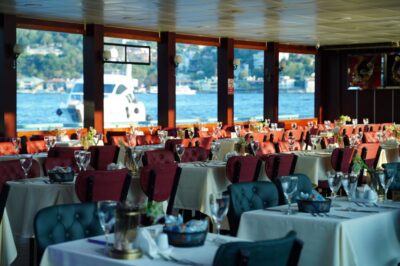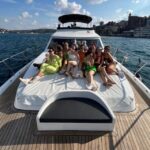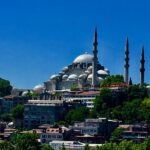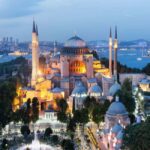
Istanbul looks different from the water. On this Bosphorus guided afternoon cruise, I like the luxury yacht feel and the fact that your English-speaking guide, Shah, turns big landmarks into a simple story you can follow in real time. You get an easy loop of iconic shores and Ottoman-era buildings, all without the stress of a museum day.
The big thing to consider is motion: this cruise is not recommended if you get vertigo or you’re prone to seasickness. If you’re good with boats and want a relaxed, photo-friendly way to see the city, it’s a very strong match.
In This Review
- Key highlights
- Planning Your Bosphorus Afternoon: What 2 Hours Looks Like
- The Bosphorus Strait: Europe Meets Asia by Water
- Dolmabahçe Palace From the Waterline: Ottoman Power at the Shore
- Çırağan Palace: Marble Splendor and Captive Chapters
- Ortaköy and the Bosphorus Bridge Footings: A Photo Stop That Feels Lived-In
- Bebek: The European Shore’s Softer, Residential Side
- Rumeli Hisarı to Anadolu Hisarı: Fortresses at the Narrowest Point
- Fatih Sultan Mehmet Bridge: Istanbul’s Modern Skyline Frame
- Küçüksu Pavilion and Beylerbeyi Palace: Summer Palace Looks Under the Bridge
- Galata Tower, Galata Bridge, and the Kız Kulesi Legend Line
- Snacks, Tea, and Why This Feels Relaxing
- Price and Logistics: When $35.39 Feels Like a Treat
- Who Should Book This Bosphorus Cruise (and Who Should Skip It)
- Should You Book This Bosphorus Guided Afternoon Cruise?
- FAQ
- How long is the Bosphorus guided afternoon cruise?
- What time does the tour start?
- Where do I meet, and does the tour end nearby?
- Is the tour offered in English?
- What is included in the price?
- Is alcohol included?
- Do I get a mobile ticket?
- How many people are on the tour?
- Is it recommended if I have vertigo or seasickness?
- What if the weather is poor?
- Is free cancellation available?
Key highlights
- A small group (max 30) keeps the vibe calm and the guide’s attention close
- English-guided route with lots of major Bosphorus landmarks and skyline views
- Snacks and drinks included: Turkish tea, lemonade, fruit plates, cookies, and baklava
- Palaces and fortresses in one ride from Dolmabahçe to Beylerbeyi, plus Rumeli and Anadolu Hisarı
- Perfect photo angles around the Bosphorus Bridge and the two-bridge skyline moment
Planning Your Bosphorus Afternoon: What 2 Hours Looks Like
This is an about 2-hour cruise that starts at 1:00 pm and ends back at the meeting point, so you’re not guessing how to get back later. The meeting location is Türkiye Petrolleri Ömer Avni, Meclis-i Mebusan Cd. No:34, 34427 Beyoğlu, İstanbul—easy to reach since it’s near public transportation.
You’ll go with a professional licensed tour guide, and the tour runs in English. It’s also capped at 30 travelers, which matters more than it sounds: smaller groups make it easier to hear explanations, take photos when you actually want them, and keep the pace relaxed instead of rushed.
Value-wise, the pricing lands at $35.39 per person, and the best part is what’s bundled. You’re not just paying for time on a boat—you’re paying for guiding plus refreshments that include tea, lemonade, cookies, baklava, and fruit plates. For many first-time visitors, that combination is what turns a scenic ride into a real Istanbul orientation.
One practical note: the experience requires good weather. If conditions are poor, you should expect either a different date or a full refund, depending on how it’s handled that day.
You can also read our reviews of more boat tours in Istanbul
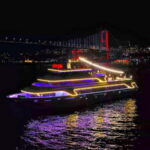
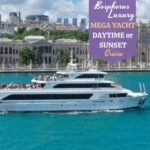
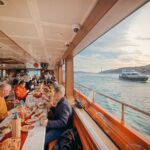
The Bosphorus Strait: Europe Meets Asia by Water
The Bosphorus is the reason Istanbul works so well as a city. It’s the strait that separates Europe and Asia, connecting the Sea of Marmara to the Black Sea. It runs roughly northeast-southwest, stretches about 30 kilometers, and has serious depth for a city waterway—about 60 meters on average, with a deepest point reaching up to 120 meters.
What you’ll feel from the cruise is simpler than the ocean science: you’re watching a living boundary. There are surface currents moving from the Black Sea toward the Marmara, and underwater currents moving the other way. That helps explain why the Bosphorus has such a distinct, busy feel day to day. Even when you’re just sitting and enjoying the view, you’re seeing a waterway that’s constantly in motion.
This is also why the route is so effective. Instead of hopping from one viewpoint to another on land, you get a moving panorama. It’s one of the fastest ways to understand Istanbul’s geography—especially where the European shore and Anatolian shore face each other.
Dolmabahçe Palace From the Waterline: Ottoman Power at the Shore
One of the first big names on the route is Dolmabahçe Palace, located in Beşiktaş on the European side. It sits between Dolmabahçe Street (stretching from Kabataş to Beşiktaş) and the Bosphorus itself, and it’s on the left bank at the entrance to the strait from the Sea of Marmara—directly opposite Üsküdar and Kuzguncuk.
It’s also huge: the palace complex covers about 250,000 square meters. From the water, what clicks is scale. You can see how the palace isn’t tucked away—it’s part of the Bosphorus shoreline story. Think of it as the sultanate-era statement that the sea route mattered as much as the palace gates.
If you love architecture but don’t want an all-day indoor ticket marathon, this kind of shoreline viewing is a great compromise. You still get the grandeur, and you keep your afternoon open.
Çırağan Palace: Marble Splendor and Captive Chapters
Next up is Çırağan Palace, commissioned by Sultan Abdulaziz and designed by the architect Sarkis Balyan. The palace was built on the site of an earlier wooden summer palace associated with Selim III. During construction, the wooden structure and a nearby Mevlevihane were destroyed.
Çırağan was completed in 1871. It’s made of marble and spreads across about 80,000 square meters. If you’re a fan of how buildings carry their past forward, this palace has layers.
After Abdulaziz was deposed, he was imprisoned there for years with his family. Later, when Murat V was deposed, he was also imprisoned at Çırağan with his family—this time for 29 years. Later still, after the Second Constitutional Monarchy in 1908, the palace served as the House of Parliament, before a fire damaged it in 1910.
Today, the palace grounds have a different use. In the early 1990s, Çırağan was restored and reopened as a luxury hotel. From the yacht, you get a useful perspective: you can see how power, politics, and later luxury can all occupy the same address over time.
Ortaköy and the Bosphorus Bridge Footings: A Photo Stop That Feels Lived-In
Ortaköy is a Beşiktaş neighborhood on the European side, built on slopes opening toward the coast. The route also connects you to the area around Ortaköy Bazaar, which is described as lively all day with an “intellectual market,” souvenir shops, cafés, bars, and restaurants. The big practical timing detail: the market movement starts after 10:00 am, so by afternoon it’s usually in motion.
What I like about pairing Ortaköy with the bridge area is contrast. Ortaköy feels like neighborhood life. Then suddenly you’re back in big infrastructure views with the Bosphorus Bridge.
This bridge matters because it was the first bridge built on the Bosphorus. Construction began in 1970, and it opened on 29 October 1973, marking the 50th anniversary of the Republic. It’s a major transportation link and also a visual symbol of Istanbul.
From the cruise perspective, the best payoff is the angle. The bridge’s feet are in Ortaköy on the European side and Beylerbeyi on the Anatolian side, so you get an easy “framing” moment—useful for skyline photos without hunting for a perfect spot on foot.
You can also read our reviews of more guided tours in Istanbul



Bebek: The European Shore’s Softer, Residential Side
Bebek is another European-side neighborhood on the Bosphorus. The name directly translates to baby, and the reference is the neighborhood’s attractive positioning along the Bosphorus shore.
Historically, Bebek has been popular since Ottoman times, and its past population reflected the diversity of society during that era. Today, you’ll notice the mix of older buildings and waterfront homes, plus major institutions like Bogazici University and waterside mansions.
On a boat, Bebek reads like a change in mood. You move from heavy palace-and-infrastructure energy toward residential calm. If your Istanbul plan includes lots of walking in old quarters, this is the kind of scenic reset that makes the day feel balanced.
Rumeli Hisarı to Anadolu Hisarı: Fortresses at the Narrowest Point
If you want a sharper sense of how the Bosphorus shaped war and defense, the fortresses are the payoff.
Rumeli Hisarı (Rumeli Fortress) is in Sariyer on the European side. It was constructed directly across from Anadolu Hisarı at the narrowest point of the Bosphorus. Sultan Mehmed the Conqueror ordered its construction to begin in 1453, and it was completed in only three months.
Before the conquest of Istanbul, it helped protect against naval attacks. After the conquest, it became an inspection point for maritime traffic on the Bosphorus. Over the centuries, small wooden houses appeared inside the fortress area, but during restoration work in 1953, those houses were removed. Today, after restoration, the site is known for summer concerts and functions as an open-air theater and museum.
Then you have the mirror site: Anadolu Hisarı (Anatolian Fortress) on the Asian side in Beykoz. It was built in 1395 by Beyazid I and includes a citadel plus outer castle walls. After the conquest, it lost much of its strategic importance and became a military hospital. Over time, the surrounding area filled in with settlement, and today you can see waterfront houses and old mansions mixed among the ruins.
Restoration ran from 1991 to 1993, and it became a museum. One important detail for expectations: it’s not open to the public in the same way as a typical museum, and you can mainly visit the outer walls. The road passes right through it, so it feels like a living ruin rather than a fenced-off exhibit.
On a cruise, these fortress stops work because you’re looking across the water at the same time you’re imagining what sailors and armies faced. It’s a simple but powerful way to understand why the Bosphorus kept getting fought over.
Fatih Sultan Mehmet Bridge: Istanbul’s Modern Skyline Frame
The Fatih Sultan Mehmet Bridge is the second Bosphorus bridge featured on the route. It spans between Kavacık and Hisarüstü. Construction began in 1986, and it opened on 3 July 1988.
This bridge carries a large portion of trans-Bosphorus traffic alongside the Bosphorus Bridge and the ferry system. It’s also described as an unmistakable part of Istanbul’s skyline. If you’re used to seeing Istanbul as old-world neighborhoods and historic waterfronts, the bridge is a helpful reminder that the city keeps evolving.
From the yacht, the bridge gives you a “modern frame” around older waterfront scenes. It’s one of those sights that makes your photos look instantly more like Istanbul.
Küçüksu Pavilion and Beylerbeyi Palace: Summer Palace Looks Under the Bridge
The itinerary also includes a Bosphorus-facing visit to Küçüksu Pavilion Museum. Ottoman emperors used Küçüksu Pavilion as a summer palace and a hunting lodge. That matters because it explains the design logic: these were leisure spaces connected to the sea and the rhythms of summer.
Then comes Beylerbeyi Palace, built in the 1860s on the shores of the Bosphorus, with the palace today sitting right under the Fatih Sultan Mehmet Bridge. It was designed by Sarkis Balyan and combines styles described as renaissance, baroque, and other influences from both East and West.
The main palace building is two-storey, made of stone on a high basement, sitting on about 2,500 square meters of land. It includes 6 halls and 24 rooms, plus a hamam and a bathroom across the two floors. The south side is organized as the Imperial Mabeyn, and the north side as the Valide Sultan’s apartment.
If you’re deciding what to focus on, don’t miss the garden side of Beylerbeyi. The route points out the lily pond and the large garden, which is often where palace experiences feel most relaxed. It’s not just about rooms and walls—it’s the way water and landscape are used to cool and soften palace life.
Galata Tower, Galata Bridge, and the Kız Kulesi Legend Line
This cruise route also reaches into Istanbul’s wider skyline legends with stops linked to Galata Tower, Galata Bridge, and Maiden’s Tower (Kız Kulesi).
Galata Tower was built by Genoese in 1348. It’s nine stories, reaching 66.90 meters, and it was the tallest building in the city when built. In Ottoman times, it served multiple roles, including fire observatory and jail.
One famous moment tied to the tower is from 1632, when Hezarfen Ahmet Çelebi glided from the top of Galata Tower across the Bosphorus to Üsküdar using self-constructed wings. During a storm in 1875, the conic roof was destroyed, and it wasn’t restored during the rest of the Ottoman era. In the 1960s, the conical cap was restored, and the wooden interior was replaced by concrete. Today, the tower is open to the public, with a restaurant and café on the upper floor—making it a strong spot for panoramic views.
Then there’s Galata Bridge, whose history begins in 1845. The bridge spans the Golden Horn, has changed many times, and it was damaged by fire in 1992. A new bridge was built, and the old version was moved to Halic. It’s a daily-life symbol: restaurants and cafés plus hookah lounges below, with the tramway and pedestrian traffic above. The bridge also supports picture-taking, especially in the evening.
Finally, Kız Kulesi (Maiden’s Tower) is described as a distinctive feature of the Bosphorus skyline. It sits on a tiny island about 200 meters from the shore at Üsküdar. It’s famous for legends, especially the story of a sultan’s daughter and an oracle predicting she’d die on her 18th birthday from a snake bite.
The legend says the tower was built to protect her by isolating her in the middle of the Bosphorus. On her 18th birthday, she receives a basket of fruits, not aware of the snake hidden inside—and she’s bitten and dies in her father’s arms as the oracle predicted. That’s how the tower got the name Maiden’s Tower.
Even if you’re not a legend person, seeing Kız Kulesi from the water makes the story make sense. The tower is small, but it’s placed so it becomes part of the skyline rhythm.
Snacks, Tea, and Why This Feels Relaxing
This cruise includes snacks and drinks, and that’s part of why it works. You’ll have Turkish tea, lemonade, water, fruit plates, and sweets like cookies and baklava. It’s not a dinner cruise, so don’t expect a full meal, but it’s enough to keep your energy steady while you’re taking in views and listening to the guide.
Alcohol is not included, and there’s a stated minimum drinking age of 18+. If you want to drink, you’ll need to plan around that.
The pace is also calm by design. With a small group and a route that connects iconic shoreline points, you can watch the city roll by without feeling like you’re sprinting. One reason this cruise gets strong love is how it blends “something to see” with “time to breathe.”
If you’re on a day when certain indoor museum plans are closed, you might find the operator offers an alternative stop so the time still stays productive. That flexibility matters when your schedule is tight.
Price and Logistics: When $35.39 Feels Like a Treat
Let’s talk value without fluff. At $35.39, you’re paying for:
- A licensed guide in English
- A luxury yacht experience
- Included snacks and drinks (tea, lemonade, fruit plates, cookies, baklava)
- A route designed around major Bosphorus landmarks
- Round-trip timing back to your meeting point after about 2 hours
For Istanbul, that’s a smart “pay once, see a lot” approach. Instead of spending that amount on one ticket and then figuring out everything else, you get food, context, and the water-level perspective bundled together.
It’s also a popular choice, with an average booking window of about 25 days in advance. If you’re traveling in a peak season or you have specific dates, it’s worth locking it in earlier so you don’t end up choosing between this and some other backup plan.
And because it requires good weather, it helps to have at least one flexible afternoon on your calendar. When the Bosphorus is clear, the experience is at its best.
Who Should Book This Bosphorus Cruise (and Who Should Skip It)
This is a great match if you:
- Want a 2-hour introduction to the Bosphorus that includes palaces, fortresses, and bridges
- Prefer seeing big sights from a boat instead of doing lots of walking
- Like having a guide connect the dots (with explanations in English)
- Enjoy snacks and tea as part of the experience rather than packing your own
It’s not a good match if you:
- Have vertigo or a history of getting seasick, since it’s explicitly not recommended for those situations
- Expect alcohol to be part of the deal
- Want an all-museum afternoon as the main focus (this is more about views plus guided context)
Should You Book This Bosphorus Guided Afternoon Cruise?
I’d book it if you’re aiming for a relaxed, high-impact Istanbul moment: the kind where Bosphorus views, palace names, bridge skylines, and Ottoman-era stories all land in one smooth 2-hour block with tea and baklava in hand.
I wouldn’t book it if boats make you nervous or if you know you won’t handle motion comfortably. In that case, you’ll be happier choosing a land-based route where you can control your comfort level.
If you’re unsure, treat this like the easiest “best of the Bosphorus” shortcut. With the small group setup, the included snacks, and the guided route, it’s one of those afternoons that gives you a lot of Istanbul context without turning your day into a marathon.
FAQ
How long is the Bosphorus guided afternoon cruise?
The cruise lasts about 2 hours.
What time does the tour start?
It starts at 1:00 pm.
Where do I meet, and does the tour end nearby?
You meet at Türkiye Petrolleri Ömer Avni, Meclis-i Mebusan Cd. No:34, 34427 Beyoğlu, İstanbul. The activity ends back at the meeting point.
Is the tour offered in English?
Yes, it is offered in English.
What is included in the price?
Included are a professional licensed tour guide and snacks such as cookies, baklava, Turkish tea, lemonade, fruit plates, and water.
Is alcohol included?
No. Alcoholic beverages are not included, and the minimum drinking age is 18.
Do I get a mobile ticket?
Yes, it includes a mobile ticket.
How many people are on the tour?
The maximum group size is 30 travelers.
Is it recommended if I have vertigo or seasickness?
No, it’s not recommended for people with vertigo or for people who are prone to seasickness.
What if the weather is poor?
The experience requires good weather. If it’s canceled due to poor weather, you’ll be offered a different date or a full refund.
Is free cancellation available?
Yes. You can cancel up to 24 hours in advance for a full refund.