REVIEW · BOSPHORUS SIGHTSEEING CRUISES
Bosphorus Sightseeing Cruise Tour with Audio Guide
Book on Viator →Operated by SeaLand Trip Bosphorus Cruise · Bookable on Viator
Bosphorus views come fast on this cruise. You glide between Istanbul’s European and Asian shores while key landmarks slide past, and you get an 11-language audio guide built around your phone. It’s a simple, scenic way to wrap your head around the city’s geography without getting stuck in traffic.
Two things I really like: the low price for a full strait cruise (it’s easy to fit even on a tight trip), and the included Turkish tea and Nescafé, which makes the whole ride feel like more than just transportation. A third bonus, if you care about pictures, is the boat’s close-up waterfront angles at multiple stops.
One drawback to plan for: the narration quality depends a lot on where you sit and on wind/engine noise, because the loudspeaker is meant for basics and safety. For the best experience, bring your own headphones and make sure your smartphone battery is topped up.
In This Review
- Key Highlights You Should Care About
- How the Bosphorus Cruise Route Really Feels
- Price and Value at Around $12.07 for 2 Hours
- Boarding at SeaLand Travel Agency in Eminönü (and Where to Aim for)
- Audio Guide Reality Check: Headphones, GPS, and Sound on Deck
- What’s Included on Board (and What You Might Want to Bring)
- From Galata Bridge to Galata Tower: The Golden Horn Warm-Up
- Hagia Sophia and Topkapi: Big Names That Change With the Angle
- Galataport and the Modern Waterfront Detour
- Dolmabahçe Area: Palaces, Mosque Details, and the Imperial “In-Between”
- Universities and Landmarks You Might Walk Past Later
- Neighborhoods Along the Bosphorus: Ortaköy, Bebek, Kuruçeşme, Arnavutköy
- Fortresses and Bridges: The Strait’s Power in Architecture
- Küçüksu Pavilion and Kandilli: Smaller Stops That Still Feel Worth It
- Beylerbeyi Palace, Kuzguncuk, Üsküdar, and the Vanishing-Into-Time Feeling
- Maiden’s Tower: The Little Islet Stop You’ll Keep Remembering
- Sunset Tips: Choosing the Left Side and Timing Your Photos
- Should You Book This Bosphorus Cruise?
- FAQ
- How long is the Bosphorus Sightseeing Cruise?
- Is the audio guide included, and what languages are available?
- Do I need to download an app for the audio guide?
- What do I need to use the audio guide?
- Are Turkish tea and Nescafé included?
- Does the boat have Wi-Fi and restrooms?
- Where do I meet for the tour, and where does it end?
Key Highlights You Should Care About
- 11 languages via a phone-based audio guide (no app download, GPS matching as you pass landmarks)
- Free Turkish tea and Nescafé that actually keep you comfortable during the ride
- Pick your seat like a pro: front/top gives you better sound, and left-side viewing can help for sunset angles
- You’ll see both palaces and neighborhoods along the Bosphorus, not just one famous strip
- A manageable 2-hour loop that gives you orientation for future days in Istanbul
- Wi-Fi on board, though signal can vary in open water
How the Bosphorus Cruise Route Really Feels
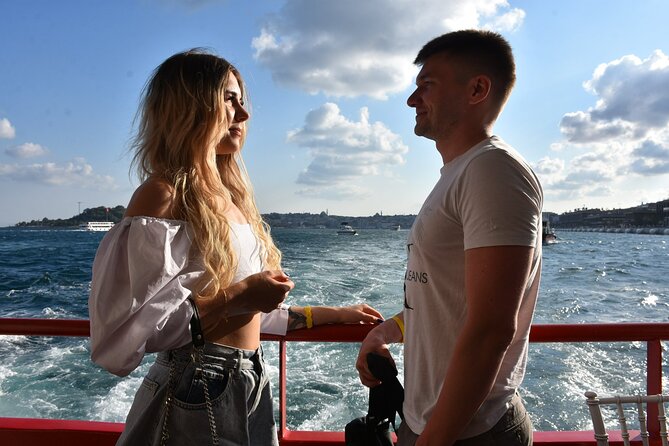
This is a “watch the shoreline, not the clock” kind of tour. In about two hours, the boat traces the Bosphorus corridor that separates Europe and Asia, so the big payoff is perspective: you start recognizing where districts sit relative to each other. Even if you’re not chasing every historical fact, you’ll finish with a mental map.
The experience is built around a passing-route format. You’ll spend your time outside for photos and skyline watching, then use the audio system to attach context to what you’re seeing. Istanbul is one of those cities where context matters, and the strait itself is the best context tool you can get quickly.
Also, the boat isn’t huge compared to some city ferries, but it can still feel crowded at peak moments. So your comfort will depend on whether you’re okay standing briefly or you want to claim a seat early.
You can also read our reviews of more boat tours in Istanbul

Price and Value at Around $12.07 for 2 Hours
At roughly $12.07 per person, you’re paying for one thing above all: time on the water with big-window views across a famous choke point of the world. Compared with full guided tours, you’re not buying a live, hands-on host who stops the boat or walks you through every monument. This is more like a well-priced sightseeing ride with a guide layer you control.
Here’s what that means for your expectations:
- You’ll get a lot of “see it from here” value for the money.
- You’re responsible for hearing the details well—mainly through your phone audio and headphones.
- You’re not going to get deep, uninterrupted, classroom-style narration.
For many first-time visitors, that trade-off is worth it. If your goal is getting bearings fast, a two-hour Bosphorus cruise at this price is hard to beat.
Boarding at SeaLand Travel Agency in Eminönü (and Where to Aim for)
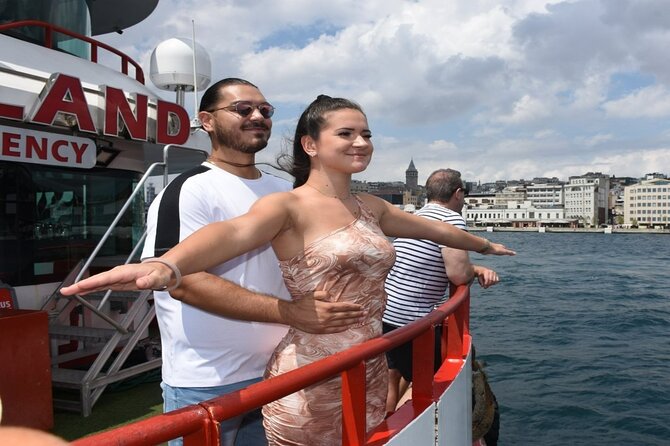
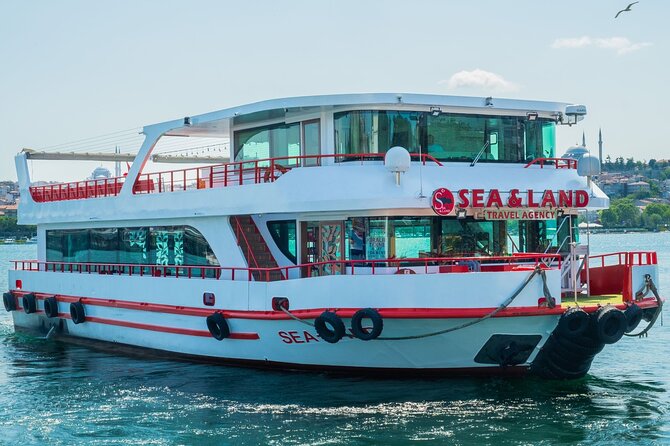
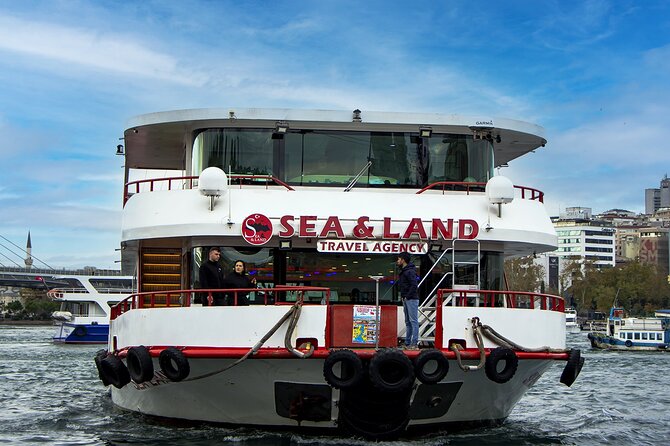
Your start point is SeaLand Travel Agency (Eminönü) near Rüstem Paşa / Ragıp Gümüşpala Cd. The key practical point is that you board right at the activity area, and you’re back where you started at the end.
Because this tour can run with up to 250 travelers, the first few minutes matter. I recommend you treat boarding like a popular ferry: be early, keep your spot, and don’t assume you’ll instantly find the perfect viewing angle.
What to aim for once onboard:
- If you want the best chance at hearing the onboard sound, go toward the front or upper areas (engine noise can drown out speakers farther back).
- If you want comfortable sitting and less deck stress, get your chair early, then plan to use your phone audio as your main narration source.
Audio Guide Reality Check: Headphones, GPS, and Sound on Deck
The audio guide is the heart of this tour, but it works differently than most guided tours. Live loudspeaker announcements are limited to general information and safety messages, while the detailed history and descriptions are primarily handled by a multilingual smartphone audio guide in 11 languages.
What you need to make that work:
- Your own headphones (this is the difference between catching the story and missing it)
- A fully charged smartphone
- No app download. You access instructions on board and then use the audio guide website. The guide uses GPS so the commentary matches what you pass.
Also, outdoor sound is not magic. When it’s windy or noisy (and boat engines are loud), onboard speakers can be hard to catch clearly. Even if the speakers are working, you might only understand fragments from certain angles.
A simple planning tip: assume your phone audio is your main channel, and let onboard sound be the backup.
What’s Included on Board (and What You Might Want to Bring)
Included benefits are straightforward:
- Unlimited free Turkish tea and Nescafé
- Wi-Fi on board
- A restroom on board
The free drinks are especially nice because they help you linger outside without feeling like you have to ration comfort. One more reason I like including tea/coffee: Istanbul days often involve a lot of walking and dust and sun, and this gives you a gentle reset.
For what to bring: besides headphones, I’d also bring a phone charger if your battery runs hot while using GPS.
You can also read our reviews of more guided tours in Istanbul




From Galata Bridge to Galata Tower: The Golden Horn Warm-Up
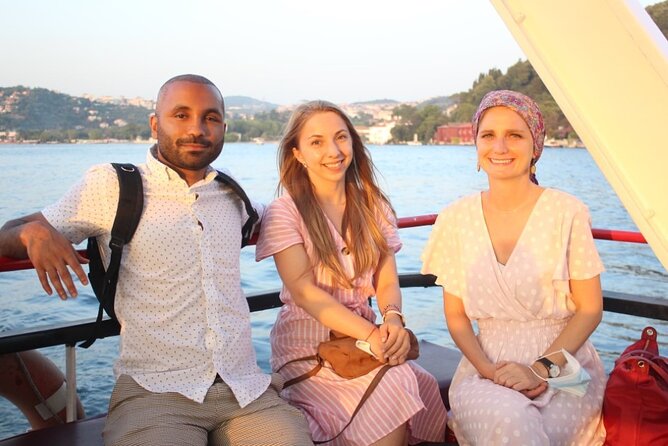
Your sightseeing starts by looking toward the Golden Horn area and the famous skyline around it.
Galata Bridge is a landmark all on its own: the current structure dates from 1994, but it connects a route that goes back to the 19th century. From the boat, you can appreciate the bridge as a street-level world with restaurants under it and fishermen above—so you’re not just viewing a structure, you’re seeing how Istanbul uses it.
Then you pass by Galata Tower (built 1348 by the Genoese). The tower isn’t only for views. It’s also tied to the legend of Hezarfen Ahmed Çelebi’s flight, and today it’s home to a museum and café. Even without going inside, it’s a strong “anchor” object that helps you orient the city’s older fabric.
If you’re thinking ahead: early on the cruise is usually when the deck is easiest to manage, so it’s a good time to claim your spot and settle in.
Hagia Sophia and Topkapi: Big Names That Change With the Angle
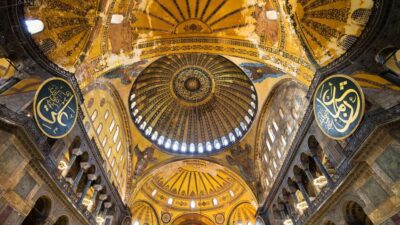
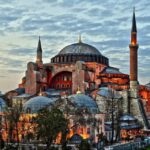
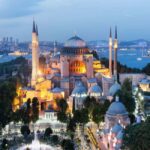
Seeing Hagia Sophia from the water is one of the reasons this cruise stays on the short list for first-timers. You’re looking at a building that was constructed in 537 as a Byzantine cathedral, then became an Ottoman mosque, and is now a mosque again. The massive dome and mosaic style are exactly the kind of details that look different depending on where the light hits.
A bit farther along, you’ll see Topkapi Palace, which served as the Ottoman sultans’ grand residence for nearly 400 years. From the Bosphorus side, it reads as an empire scale moment: courtyards, structures, and the sense that the city used the water both for power and for connection.
Reality check for expectations: the cruise provides views and audio context, not a full guided walk through these sites. If you want to linger at an entrance and go inside, plan to do that on a separate day.
Galataport and the Modern Waterfront Detour
Not every stop is postcard-old Istanbul. Galataport (Galata Cruise Port) is a modern waterfront hub opened in 2021, designed for international cruise ships. You’ll see the idea of a new Istanbul—an underground terminal, plus shops, restaurants, and museums.
This matters because it shows how the Bosphorus corridor isn’t just a museum line. It’s also a working waterfront that’s changing as visitor traffic grows.
If you like contrast, this is a useful moment to notice how quickly the city can shift from “historic landmark mass” to “modern visitor infrastructure.”
Dolmabahçe Area: Palaces, Mosque Details, and the Imperial “In-Between”
The Dolmabahçe stretch is where the cruise starts feeling especially “Istanbul-specific.” You’ll pass:
- Dolmabahçe Mosque, finished in 1855, where Ottoman mosque design meets Western influence.
- Beşiktaş Stadium (Vodafone Park), home of Beşiktaş J.K.
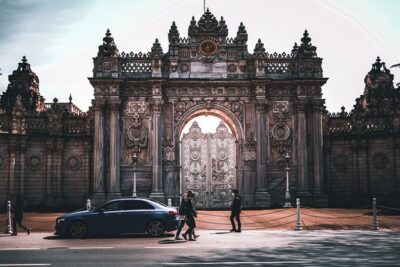
- Dolmabahçe Palace, the Ottoman Empire’s main administrative center from 1856 to 1922.
- Çırağan Palace, another 19th-century Ottoman imperial palace along the Bosphorus.
- Cihangir Mosque in the Cihangir neighborhood, built in the 16th century during Sultan Suleiman the Magnificent’s reign and named after his son Cihangir.
This whole cluster gives you a sense of the Ottoman “in-between” period—when the empire’s identity was still Ottoman, but the design language was absorbing outside styles. Even if you don’t memorize dates, the visuals help.
Also pay attention to Ortaköy. It’s known for cafés, art galleries, and Bosphorus views, so you’ll see a more casual, lived-in side of the shoreline rather than only ceremonial architecture.
Universities and Landmarks You Might Walk Past Later
As the boat continues, you’ll spot big institutions that shape the city beyond tourism:
- Mimar Sinan University of Fine Arts, founded in 1882, named after architect Mimar Sinan (architecture, fine arts, design).
- Galatasaray University, founded in 1481 as a school for the Ottoman elite.
- Galatasaray Island, a private island near Istanbul in the Sea of Marmara, owned by Galatasaray University and used for educational and recreational purposes.
These stops are not “must-see monuments” in the same way as Hagia Sophia, but they’re valuable because they show how Istanbul keeps education and youth culture on the water’s edge.
If you’re planning a longer trip, these are useful clues. You can decide later whether you want to explore an area that feels like it has local energy.
Neighborhoods Along the Bosphorus: Ortaköy, Bebek, Kuruçeşme, Arnavutköy
One of the strongest values of a cruise like this is that it keeps moving, so your brain connects the dots between neighborhoods.
Here are the shoreline styles you’ll notice:
- Ortaköy: café-and-gallery vibe with Bosphorus views.
- Kuruçeşme: upscale dining and stylish waterfront atmosphere.
- Arnavutköy: older wooden houses and narrow lanes that still feel village-like even near the center.
- Bebek: parks, luxury homes, and waterfront strolling energy.
- Kuruçeşme and Arnavutköy also pair well with the photo problem Istanbul gives you: straight streets are rare. The water line becomes your visual guide.
You may also pass by official buildings like the Consulate General of the Arab Republic of Egypt in Bebek, which is a reminder that this shoreline is global, not only local.
Fortresses and Bridges: The Strait’s Power in Architecture
As you approach the more dramatic scenery, Istanbul’s geography becomes obvious. The strait funnels travel, and the city responded by building defenses right on the water.
On the European side you’ll see Rumeli Fortress (Rumeli Hisarı). It overlooks the Bosphorus and works like a watchful punctuation mark: here’s where the empire controlled movement across the water.
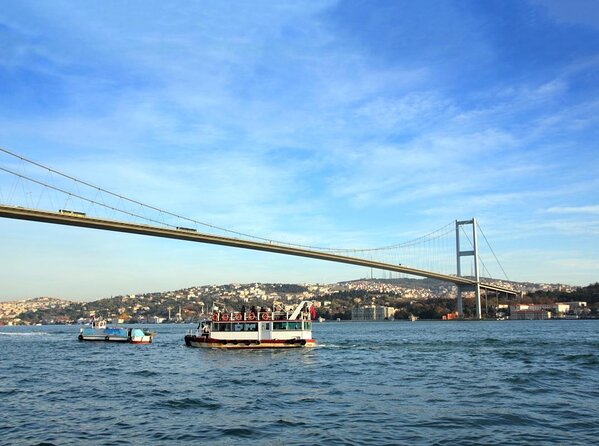
Later, you’ll pass the Bosphorus Bridge, officially the 15 July Martyrs Bridge, connecting Europe and Asia.
Then there’s the Fatih Sultan Mehmet Bridge, the second Bosphorus crossing.
On the Asian side, you’ll see Anatolian Fortress (Anadoluhisarı), overlooking the Bosphorus from the opposite bank. With both fortresses in view during your cruise, the “why here” of Istanbul’s defensive architecture becomes much clearer than it is on a map.
Küçüksu Pavilion and Kandilli: Smaller Stops That Still Feel Worth It
These are the calmer moments. Along the Asian shore you’ll pass Küçüksu Pavilion, built in the 19th century by Sultan Abdulmecid I as a summer retreat for the sultans. You’ll also see Kandilli, a peaceful neighborhood on the Asian side of Istanbul along the Bosphorus, and Kuleli Military High School, a historic military school overlooking the water.
These stops may not dominate headlines, but that’s exactly why I like them. They add rhythm to a cruise that can otherwise feel like a parade of super-famous sights.
If you’re trying to understand the whole city—how it lives when it’s not in postcard mode—these quieter shoreline sections do the job.
Beylerbeyi Palace, Kuzguncuk, Üsküdar, and the Vanishing-Into-Time Feeling
As you move further along the Asian side, you’ll pass:
- Istanbul Yalı, historic waterfront mansions known for their architecture and prime locations.
- Beylerbeyi Palace, an Ottoman-era palace on the Asian side of the Bosphorus.
- Kuzguncuk, a charming historic neighborhood on the Asian shore along the Bosphorus.
- Üsküdar, a historic neighborhood along the Bosphorus.
This stretch is where the shoreline starts to feel like a living collage: mansions, neighborhoods, palaces, and institutional buildings all sharing the same narrow strip of waterfront.
And that’s the real value of the cruise. It doesn’t just show you famous monuments. It shows you how Istanbul stacks life next to history.
Maiden’s Tower: The Little Islet Stop You’ll Keep Remembering
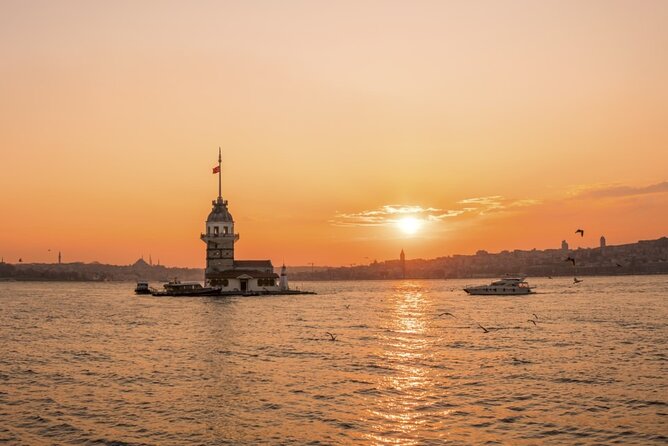
At the end of your sightseeing loop, you’ll encounter Maiden’s Tower (Kız Kulesi), a small historic tower on a tiny islet at the entrance of the Bosphorus.
This is one of those sights that photographs almost too well. From the water, you can really see the isolation of the tower—small, deliberate, and positioned like a landmark for ships entering and leaving.
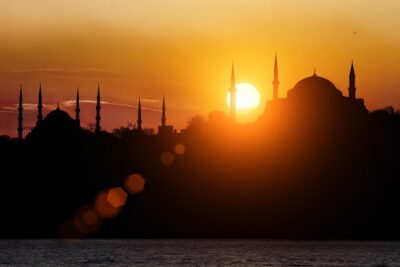
If you’re going for a sunset run, this is also the kind of stop that looks great as the light changes.
Sunset Tips: Choosing the Left Side and Timing Your Photos
If you’re doing this in late afternoon or early evening, you’ll get a daylight-to-night feel in about two hours, and that lighting shift is a major part of why this cruise is so popular.
From practical advice tied to the route: if you want darker, dramatic views of landmarks on the return leg (especially around Hagia Sophia), sit on the left side of the boat. Combine that with your earlier seat choice for sound, and you’ll get the best of both worlds: a readable story and better photo contrast.
Should You Book This Bosphorus Cruise?
I’d book it if:
- You want orientation fast on your first Istanbul day.
- You like seeing famous landmarks without spending hours in lines.
- You’re okay using a phone-based audio guide and bringing headphones.
- You value cheap scenic time over a full, stop-and-explain guided experience.
I’d think twice if:
- You need a louder, more traditional live guide narrating every stop with no tech involved.
- You hate crowds and want maximum quiet and space.
- You plan to rely only on onboard speakers—sound can be difficult in wind and from certain seating spots.
If your trip includes a day for Hagia Sophia and Topkapi Palace interiors, this cruise works as the perfect warm-up. You’ll recognize what you saw from the water as soon as you step onto land.
FAQ
How long is the Bosphorus Sightseeing Cruise?
The cruise lasts about 2 hours.
Is the audio guide included, and what languages are available?
Yes. The tour includes an audio guide in 11 languages.
Do I need to download an app for the audio guide?
No. The audio guide uses a smartphone website and does not require an app download. Instructions are posted on the boat.
What do I need to use the audio guide?
You need your own headphones and a fully charged smartphone to access the audio guide website.
Are Turkish tea and Nescafé included?
Yes. Turkish tea and Nescafé are included as unlimited free drinks.
Does the boat have Wi-Fi and restrooms?
Wi-Fi is provided on board, and there is a restroom on board.
Where do I meet for the tour, and where does it end?
You meet at SeaLand Travel Agency (Eminönü) and the cruise ends back at the same meeting point.